Same 149cc engine, different tech — here's what actually separates them
If you're shopping for a 150cc commuter bike in 2026, chances are Yamaha's FZ-S FI has already made your shortlist. But now Yamaha has made the choice a little trickier by offering two versions — the standard FZ-S FI and the FZ-S FI Hybrid, India's first hybrid motorcycle in the 150cc segment. Both look nearly identical at first glance and share the same engine, so what are you actually paying extra for with the Hybrid?
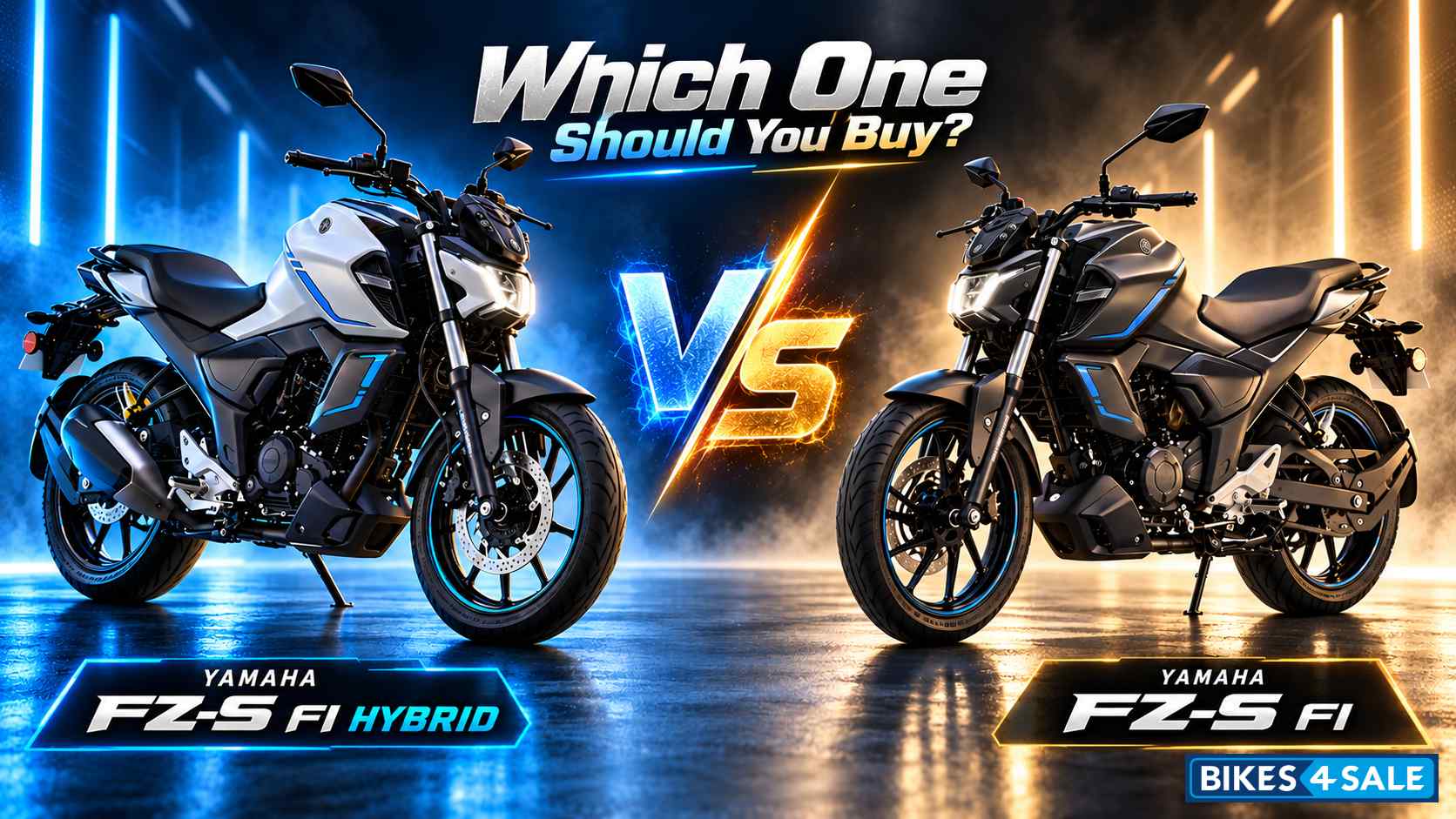
We've broken down the real differences below — mileage, features, ride quality, and price — so you can decide which one suits your daily commute better.
(Prices for both variants vary slightly by state and change from time to time. We'd recommend checking the current price on the website before making your final decision.)
Here's the first thing worth knowing — the engine itself hasn't changed. Both bikes run the same 149cc, air-cooled, fuel-injected motor producing 12.4 PS and 13.3 Nm of torque. So if you're expecting the Hybrid to feel noticeably quicker or more powerful, it won't. The riding experience, throttle response, and top speed are practically the same on both bikes. The difference isn't about raw performance — it's about how smartly the engine manages itself.
The FZ-S FI Hybrid's headline feature is Yamaha's Smart Motor Generator (SMG) system, paired with a Stop & Start System. In simple terms, the SMG gives the engine a small electric assist during acceleration, and the Stop & Start feature automatically switches the engine off when you're stationary in traffic and restarts it instantly when you release the brake. This is meant to reduce fuel wastage during India's stop-and-go city traffic, which is where most FZ owners actually ride.
Along with this, the Hybrid gets a full-colour TFT display instead of the standard bike's digital screen, with turn-by-turn navigation and music control through Yamaha's Y-Connect app — genuinely useful if you rely on Google Maps for your daily commute.
This is the part most buyers care about most. Yamaha's official ARAI-certified mileage figures for the Hybrid are higher than the standard FZ-S FI, largely because of the Stop & Start technology cutting fuel use at traffic signals. That said, ARAI figures are tested under controlled conditions, and real-world city mileage — especially in heavy traffic — typically comes in noticeably lower than the certified number for any 150cc bike, hybrid or not. If your daily ride involves long highway stretches with fewer stops, the mileage gap between the two versions will be smaller than what you'd see riding through a crowded city.
Beyond the hybrid tech, both bikes share the same chassis, suspension setup (telescopic front fork with a 7-step adjustable rear monoshock), tyre sizes, and seat height, so the actual riding posture and handling feel identical. Both are E20-fuel compatible and come with a traction control system as standard. The Hybrid is about 1 kg heavier, which is barely noticeable while riding.
The Hybrid variant costs more than the standard FZ-S FI, and that extra amount goes entirely toward the SMG hybrid system, Stop & Start technology, and the upgraded TFT display with navigation. There's no difference in engine performance, so you're essentially paying for smarter fuel efficiency and better connectivity features, not more power. Since ex-showroom prices shift slightly by state and can be revised by Yamaha, we'd recommend checking the current price on the website before making your final decision.
Go with the standard FZ-S FI if you want the classic FZ riding experience at a lower price, don't need turn-by-turn navigation on your dash, and mostly ride on open roads with fewer stop-start situations.
Go with the FZ-S FI Hybrid if you commute daily through heavy city traffic, want the added convenience of a TFT display with navigation, and value the extra fuel efficiency the Stop & Start system brings over your ownership period.
Either way, you're getting the same reliable 149cc engine underneath — the Hybrid just wraps it in smarter technology built specifically for Indian city commuting.
We've broken down the real differences below — mileage, features, ride quality, and price — so you can decide which one suits your daily commute better.
Quick Comparison: FZ-S FI vs FZ-S FI Hybrid
| Feature | 2026 FZ-S FI | 2026 FZ-S FI Hybrid |
|---|---|---|
| Engine | 149cc, air-cooled, SOHC, 2-valve | 149cc, air-cooled, SOHC, 2-valve |
| Max Power | 12.4 PS @ 7,250 rpm | 12.4 PS @ 7,250 rpm |
| Max Torque | 13.3 Nm @ 5,500 rpm | 13.3 Nm @ 5,500 rpm |
| Hybrid Assist | Not available | Smart Motor Generator (SMG) + Stop & Start System |
| Display | Digital instrument cluster | Full-colour TFT with turn-by-turn navigation |
| Kerb Weight | 137 kg | 138 kg |
| Front Brake | Disc, 282mm, single-channel ABS | Disc, 282mm, single-channel ABS |
| Fuel Tank | 13 litres | 13 litres |
| Seat Height | 790mm | 790mm |
(Prices for both variants vary slightly by state and change from time to time. We'd recommend checking the current price on the website before making your final decision.)
Engine and Performance: No Difference Here
Here's the first thing worth knowing — the engine itself hasn't changed. Both bikes run the same 149cc, air-cooled, fuel-injected motor producing 12.4 PS and 13.3 Nm of torque. So if you're expecting the Hybrid to feel noticeably quicker or more powerful, it won't. The riding experience, throttle response, and top speed are practically the same on both bikes. The difference isn't about raw performance — it's about how smartly the engine manages itself.
What the Hybrid Actually Adds
The FZ-S FI Hybrid's headline feature is Yamaha's Smart Motor Generator (SMG) system, paired with a Stop & Start System. In simple terms, the SMG gives the engine a small electric assist during acceleration, and the Stop & Start feature automatically switches the engine off when you're stationary in traffic and restarts it instantly when you release the brake. This is meant to reduce fuel wastage during India's stop-and-go city traffic, which is where most FZ owners actually ride.
Along with this, the Hybrid gets a full-colour TFT display instead of the standard bike's digital screen, with turn-by-turn navigation and music control through Yamaha's Y-Connect app — genuinely useful if you rely on Google Maps for your daily commute.
Mileage: What to Actually Expect
This is the part most buyers care about most. Yamaha's official ARAI-certified mileage figures for the Hybrid are higher than the standard FZ-S FI, largely because of the Stop & Start technology cutting fuel use at traffic signals. That said, ARAI figures are tested under controlled conditions, and real-world city mileage — especially in heavy traffic — typically comes in noticeably lower than the certified number for any 150cc bike, hybrid or not. If your daily ride involves long highway stretches with fewer stops, the mileage gap between the two versions will be smaller than what you'd see riding through a crowded city.
Features and Comfort
Beyond the hybrid tech, both bikes share the same chassis, suspension setup (telescopic front fork with a 7-step adjustable rear monoshock), tyre sizes, and seat height, so the actual riding posture and handling feel identical. Both are E20-fuel compatible and come with a traction control system as standard. The Hybrid is about 1 kg heavier, which is barely noticeable while riding.
Price: What You're Really Paying For
The Hybrid variant costs more than the standard FZ-S FI, and that extra amount goes entirely toward the SMG hybrid system, Stop & Start technology, and the upgraded TFT display with navigation. There's no difference in engine performance, so you're essentially paying for smarter fuel efficiency and better connectivity features, not more power. Since ex-showroom prices shift slightly by state and can be revised by Yamaha, we'd recommend checking the current price on the website before making your final decision.
Which One Should You Buy?
Go with the standard FZ-S FI if you want the classic FZ riding experience at a lower price, don't need turn-by-turn navigation on your dash, and mostly ride on open roads with fewer stop-start situations.
Go with the FZ-S FI Hybrid if you commute daily through heavy city traffic, want the added convenience of a TFT display with navigation, and value the extra fuel efficiency the Stop & Start system brings over your ownership period.
Either way, you're getting the same reliable 149cc engine underneath — the Hybrid just wraps it in smarter technology built specifically for Indian city commuting.
FAQ
| Is the Yamaha FZ-S FI Hybrid worth the extra price? |
| If you ride mostly in city traffic with frequent stops, the Stop & Start system and SMG assist can genuinely improve your fuel efficiency over time, making the extra cost worthwhile. If you ride mostly on open roads, the difference will be smaller. |
| Does the FZ-S FI Hybrid have more power than the standard FZ-S FI? |
| No, both bikes use the same 149cc engine producing 12.4 PS and 13.3 Nm of torque. The Hybrid's SMG system assists during acceleration but doesn't increase the bike's peak output. |
| What is the Smart Motor Generator (SMG) system in the Yamaha FZ-S FI Hybrid? |
| SMG is Yamaha's mild-hybrid technology that gives the engine a small electric boost during acceleration and enables automatic engine stop-start at traffic signals, helping improve real-world fuel efficiency in city riding. |
| Which Yamaha FZ-S FI variant is better for daily office commuting? |
| The FZ-S FI Hybrid is better suited for daily office commuting through city traffic, since its Stop & Start system and TFT navigation are designed specifically for stop-and-go riding conditions. |