
Bikes4Sale Price Guide : Used Bike Valuation Tool
Know the market value of your used bike
KMs Run
| Selected Bikes |  BMW S 1000 XR 2021
Brand: Model: |
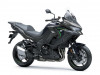 Kawasaki Versys 1100 2025
Brand: Model: |
Brand: Model: |
Brand: Model: |
| Fuel | Petrol | Petrol | ||
| Engine Displacement | 999.00 cc | 1099.00 cc | ||
| Engine | Water/oil-cooled 4-cylinder 4-stroke in-line engine, four valves per cylinder, two overhead camshafts | Liquid-cooled, 4-stroke, in-line four, DOHC, 16 valves | ||
| Engine Starting | -- | Electric | ||
| Engine Lubrication | -- | Forced lubrication, wet sump | ||
| Clutch | Multiplate clutch in oil bath, anti-hopping clutch, mechanically controlled | Wet, multi disc | ||
| Fuel System | Electric fuel injection | Fuel injection: 38 mm x 4 | ||
| Ignition | -- | Digital | ||
| Cooling System | Water/oil-cooled | Liquid-cooled | ||
| Maximum Power | 165 PS @ 11000 rpm | 135 Ps @ 9000 rpm | ||
| Maximum Torque | 114 Nm @ 9250 rpm | 112 Nm @ 7600 rpm | ||
| Load Carrying Capacity | Permitted total weight: 444 kg Payload (with standard equipment): 216 kg |
-- | ||
| Transmission | -- | 6-speed, return shift | ||
| Gear Shift Pattern | Six-speed synchromesh gearbox with spur gears | -- | ||
| Drivetrain | Chain 17/45 | Final drive: Sealed chain | ||
| Top Speed | 200 kmph | -- | ||
| Battery | 12 V/8 Ah, maintenance-free | -- | ||
| Frame | Aluminium composite bridge frame, partially self-supporting engine | Twin-tube aluminium | ||
| Headlamp | -- | LED | ||
| Taillamp | -- | LED |
| Overall Mileage | 20 kmpl | 17.8 kmpl |
| Front | 120/70 ZR 17 | 120/70 ZR17 M/C (58W) | ||
| Rear | 190/55 ZR 17 | 180/55 ZR17 M/C (73W) | ||
| Wheel / RIM | Cast aluminium Rim dimensions, front: 3.50 x 17" Rim dimensions, rear: 6.00 x 17" |
-- |
| Front | Twin disc brakes, diameter 320 mm, floating discs, radial four-piston fixed calipers | 310 mm Dual semi-floating discs Dual radial-mount, monobloc, opposed 4-piston |
||
| Rear | Single disc brake, diameter 265 mm, twin-piston floating caliper | 260 mm Single disc, Single-piston | ||
| ABS | BMW Motorrad Race ABS, partially integral, switchable | -- |
| Front | Upside-down telescopic fork, diameter 46 mm, rebound/compression damping adjustable | 43 mm Inverted fork with adjustable rebound damping, and spring preload adjustability, 150 mm travel | ||
| Rear | Aluminium double-sided swing-arm, central spring strut, adjustable rebound-stage damping | Horizontal Back-link, gas-charged shock, rebound damping, and remote spring preload adjustability, 152 mm travel |
| Colors | Racing Red Ice Grey |
Metallic Matte Graphenesteel Gray/ Metallic Diablo Black |
| Length | 2183 mm | 2270 mm | ||
| Width | 940 mm | 895 mm | ||
| Height | 1408 mm | 1400 mm | ||
| Weight | -- | 235 kg | ||
| Kerb Weight | 228 | 257 | ||
| Seat Height | 840 | 820 | ||
| Wheelbase | 1548 mm | 1520 mm | ||
| Ground Clearance | -- | 150 mm | ||
| Fuel Tank Capacity | 20 litres | 21 litres |
| About | -- | The 2025 Kawasaki Versys 1100 maintains steady performance with its 1099 cc liquid-cooled, in-l Read More | ||
| Features | Equipment - Transparent windscreen, adjustable in two stages - One-piece seat (seat height: 840 mm; step length: 1,895 mm) - One key system for ignition, steering, fuel filler cap and seat locks - Integrated ignition and steering lock - Adjustable handbrake lever - Storage compartment beneath the passenger seat - On-board literature Electrical system - Lights permanently illuminated - Headlamps and high-beam headlamps, asymmetrically arranged - Multi-functional display, dimmable - Single Wire System (CAN Bus) - Electronic immobilizer - Three-phase generator 486 W and 12 V power socket - Drop sensor - Diagnostic interface - Hazard warning lights system - Smoked indicators and LED rear light Special features - 2 adjustable riding modes "Rain" and "Road": BMW Motorrad Race ABS and ASC (Automatic Stability Control) adjusted to the riding modes - Multi-disc oil bath clutch, anti-hopping, mechanically actuated - Removable number-plate carrier |
- USB Type-C Socket | ||
| Additional Details | Consumption per 100 km based on the WMTC: 6.7 l Fuel type : Premium unleaded, 95–98 octane (RON) (knock control; nominal load capacity with 98-octane fuel) Emission Control: Closed-loop 3-way catalytic converter, emission standard EU-4, with interference pipe Castor: 117 mm Steering head angle: 64.5° Automatic Stability Control Seat height: 840 mm (HP Sports seat, high (accessory): 855 mm; Suspension kit (OE): 790 mm) Inner leg curve: 1.880 mm (lower suspension* 1.790mm) OE* |
Trail: 106 mm Steering angle L/R: 34° / 34° |
Get the best price for your old bike. Sell your bike at the Largest Used Bike Market.

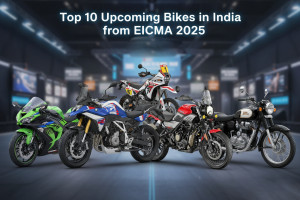 Top 10 Upcoming Bikes in India from EICMA 2025
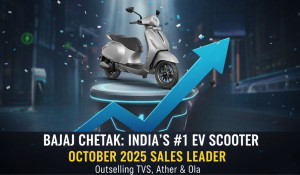 Bajaj Chetak Tops India’s EV Scooter Sales
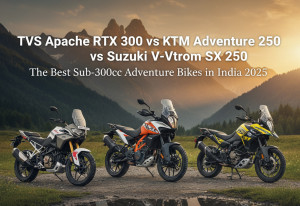 TVS Apache RTX 300 vs KTM Adventure 250 vs Suzuki V-Strom SX 250: The Best Sub-300cc Adventure Bikes in India 2025